



Electric Vehicle Handling Qualified (EVHQ) Program
The OEC Certified Repair Network works with industry experts and our OEM partners to deliver industry standards and best practices for the safe handling of electric vehicles after a collision. The EVHQ program is designed to help collision centres understand the required equipment and processes to safely handle electric vehicles after a collision.
OEC connects collision shops, vehicle manufacturers, and insurance companies through one common goal: enhancing consumer safety. But as vehicle technology advances, so does the complexity of the repair. Every day, technicians face more complex repairs as emerging vehicle technologies become a part of the day-to-day work experience. Sounds complicated, but that’s why OEC CRN solutions provide tools and resources to help the industry make quality, safe repairs easier.
Why EVHQ?
As the number of electric and electric hybrid vehicles on the roads today continues to increase, collision centres across North America must be prepared to safely manage the handling of these vehicles when they arrive at their facility.
Are you prepared to handle Electric Vehicles?
Collision centres need to be prepared for the potential dangers of handling electric vehicles. Dangers after a collision are not limited to electrical shock injuries from the high voltage system. There is also significant danger from fire and toxic gas in the event of a combustion event. There are additional liabilities with improper handling or repair of electric vehicles.
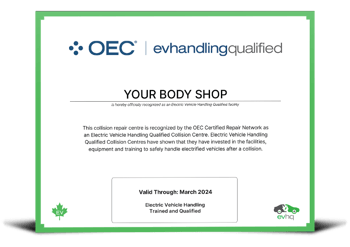
The Electric Vehicle Handling Qualified (EVHQ) program has been developed by industry experts to identify, qualify and promote EV Ready collision centres across North America. The EVHQ program provides shops with the information and training to help their staff understand the dangers, processes and tooling recommended to safely handle EVs at their facility. It also provides consumers and insurers an easy way to find a collision centre that has demonstrated they are prepared to safely handle Electric Vehicles after a collision.
How can you let your customers, community and business partners know you have made the investment in the tools and training necessary to properly receive EVs after a collision?
Becoming Electric Vehicle Handling Qualified provides recognition that you have the facility, equipment, tooling and understanding of what is needed to safely handle High-Voltage Vehicles.

DISCLAIMER:
EVHQ is a qualification program only. You are the expert and shall be solely liable for the repair of any vehicle you choose to perform repairs. Proper service and repair procedures are vital to the safe, reliable operation of all motor vehicles, as well as the personal safety of those performing repairs or maintenance procedures. Safety procedures and precautions should be followed at all times to avoid personal injury, illness, death or property damage, and to avoid compromising the safety of the vehicle or third parties. The information provided is not intended as a substitute for your professional training and knowledge.
ALTHOUGH THIS MATERIAL HAS BEEN PREPARED WITH THE INTENT TO PROVIDE RELIABLE INFORMATION, NO WARRANTY, EITHER EXPRESS OR IMPLIED, IS MADE AS TO ITS ACCURACY OR COMPLETENESS. NO LIABILITY IS ASSUMED FOR ANY LOSS, INJURY TO PERSONS, PROPERTY OR OTHER DAMAGE RESULTING FROM EITHER THE USE OF OR RELIANCE ON THE MATERIAL PRESENTED OR THE INFORMATION CONTAINED IN THE MATERIALS. WITHOUT LIMITATION, NO WARRANTY OF MERCHANTABILITY, FITNESS FOR A PARTICULAR PURPOSE OR ANY OTHER WARRANTY, EXPRESS OR IMPLIED, IS MADE WITH RESPECT TO THE MATERIAL ON THIS SITE. IN NO EVENT WILL OECONNECTION OR ANY OF ITS AFFILIATED COMPANIES, OFFICERS, EMPLOYEES, DIRECTORS, AGENTS OR REPRESENTATIVES BE LIABLE FOR ANY DAMAGES, DIRECT OR INDIRECT, CONSEQUENTIAL, COMPENSATORY, PUNITIVE OR OTHERWISE, ARISING OUT OF THE USE OF, OR ANY RELIANCE UPON ANY MATERIAL PRESENTED OR THE INFORMATION CONTAINED IN THE MATERIALS. WITHOUT LIMITATION OF THE FOREGOING, THE MATERIALS CONTAINED IN THIS WEBSITE, INCLUDING GRAPHICS, TEXT, LINKS, AUDIO OR VISUAL MATERIALS, ARE PROVIDED SOLELY ON AN “AS IS” BASIS. YOU ARE VIEWING THE MATERIALS AND USING THE INFORMATION CONTAINED IN THE MATERIALS AT YOUR SOLE RISK.


Electric Vehicle Handling Qualified
Is your facility ready to take the next step and become EVHQ | Electric Vehicle Handling Qualified?
EVHQ Requirement List – updated 06.21.2023*
List of Required Equipment:
-
Insulated Gloves – cotton inner, rubber insulated, protective leather.
-
Safety Glasses (OSHA approved)
-
CPR First Aid Response Kit
-
Shepherds Hook – 6 ft
-
Class C fire-rated, ABC or BC Dry Chemical Fire Extinguisher
-
EV Fire Blanket
-
Stickers and Signage (High Voltage Warnings, Battery Warning Stickers – Technical Data Plates – Electrocution Risk – High Voltage)
-
2 post lift (rated 3,500kg)
-
DVOM (Digital Volt/Ohm Multimeter) with HV probe - CAT III 1000V
-
HV Battery Charger (level 1,2 or 3)
-
Smart Charger (low voltage)
-
High Voltage Cable Cutters
-
Insulated Hand Tools
-
LOTO Lock and Labels (Lock-Out/Tag-Out)
-
Mobile Safety Barriers (enclose workspace, enclose quarantine areas)
-
Digital Thermometer
-
Wheeled Dollies - (4 min)
Recommended additional best practices:
-
Face Shield
-
EH Rated Shoes
-
Respirator – min. of half mask with P100 and general-purpose charcoal filters
-
AED (Automated External Defibrillator) - with trained team member
-
Resuscitation Bag
-
Balaclava
-
Heat Resistant Clothing
-
Burn Kit
-
Thermal Imaging Camera
-
Electric Isolation Mat
-
EV Rubber Glove Tester
-
Class D Fire Extinguisher
- Quarantine Areas
EVHQ – Electric Vehicle Handling Qualified Instructional Module Requirement
It is encouraged that every staff member at your collision centre take the EVHQ Instructional Modules.
For EVHQ completion, one person in each of the two (2) roles listed below must complete and pass the EVHQ Instructional Modules to meet EVHQ requirements. One (1) person may not satisfy the requirements for multiple roles.
- 1. At least one (1) estimator
- 2. At least one (1) structural technician
Additional EVHQ Instructional Modules may be introduced. The Repair facility will be advised via email as new classes are introduced and will have 120 days from the date that a given class is announced to complete any additional modules.
*This list may be updated from time to time, it is your responsibility to keep current on OEM and industry expert required equipment and best practices.
DISCLAIMER:
EVHQ is a qualification program only. You are the expert and shall be solely liable for the repair of any vehicle you choose to perform repairs. Proper service and repair procedures are vital to the safe, reliable operation of all motor vehicles, as well as the personal safety of those performing repairs or maintenance procedures. Safety procedures and precautions should be followed at all times to avoid personal injury, illness, death or property damage, and to avoid compromising the safety of the vehicle or third parties. The information provided is not intended as a substitute for your professional training and knowledge.
ALTHOUGH THIS MATERIAL HAS BEEN PREPARED WITH THE INTENT TO PROVIDE RELIABLE INFORMATION, NO WARRANTY, EITHER EXPRESS OR IMPLIED, IS MADE AS TO ITS ACCURACY OR COMPLETENESS. NO LIABILITY IS ASSUMED FOR ANY LOSS, INJURY TO PERSONS, PROPERTY OR OTHER DAMAGE RESULTING FROM EITHER THE USE OF OR RELIANCE ON THE MATERIAL PRESENTED OR THE INFORMATION CONTAINED IN THE MATERIALS. WITHOUT LIMITATION, NO WARRANTY OF MERCHANTABILITY, FITNESS FOR A PARTICULAR PURPOSE OR ANY OTHER WARRANTY, EXPRESS OR IMPLIED, IS MADE WITH RESPECT TO THE MATERIAL ON THIS SITE. IN NO EVENT WILL OECONNECTION OR ANY OF ITS AFFILIATED COMPANIES, OFFICERS, EMPLOYEES, DIRECTORS, AGENTS OR REPRESENTATIVES BE LIABLE FOR ANY DAMAGES, DIRECT OR INDIRECT, CONSEQUENTIAL, COMPENSATORY, PUNITIVE OR OTHERWISE, ARISING OUT OF THE USE OF, OR ANY RELIANCE UPON ANY MATERIAL PRESENTED OR THE INFORMATION CONTAINED IN THE MATERIALS. WITHOUT LIMITATION OF THE FOREGOING, THE MATERIALS CONTAINED IN THIS WEBSITE, INCLUDING GRAPHICS, TEXT, LINKS, AUDIO OR VISUAL MATERIALS, ARE PROVIDED SOLELY ON AN “AS IS” BASIS. YOU ARE VIEWING THE MATERIALS AND USING THE INFORMATION CONTAINED IN THE MATERIALS AT YOUR SOLE RISK.

Certified Collision Care EV Certification Program
Join the movement. Lead the future of EV collision repair.
Certified Collision Care: Your Advantage in the Rapidly Growing EV Market
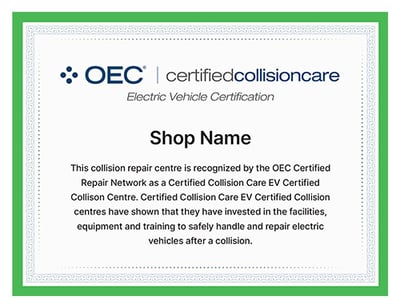
As electric vehicles (EVs) surge in popularity across Canada, consumers and insurers are demanding one thing: confidence that collision repairs are done safely, properly, and to exact OEM standards. Certified Collision Care is leading the charge with an exclusive EV Certification Program that identifies facilities equipped and qualified to restore EVs after a collision. Our program helps shops stand out as trusted experts in this fast-expanding segment of the automotive industry.
Benefits for Your Shop
- Stay ahead of industry trends
- Build trust with insurers and EV owners
- Increase repair volume and revenue
Why It Matters
EVs require specialized knowledge, equipment, and safety protocols. Our program ensures your shop is fully prepared to meet OEM standards and deliver safe, high-quality repairs.
Program Highlights
- OEM-Approved Requirements
- One set of core standards for equipment, tooling, and training approved by all 13 OEMs
- Hands-On Training
- Access practical experience at the new EV Centre of Excellence in Milton, Ontario
- Exclusive Designation
- Certified shops receive a special EV badge on locators and insurer reporting, driving more EV repair opportunities to your door
Join the Movement. Get Certified. Lead the Future of EV Collision Repair
Tooling
- Insulated Socket Set*
- Insulated Plier Set*
- Insulated Wrench Set*
- Insulated Screwdriver Set*
- Insulated Socket Extension Set*
- High Voltage Digital Multimeter
- High Voltage Battery Leak Tester
- Battery Coolant Leak Down Tester
- Vac-n-fill Coolant Refill Tool
- Thermal Imaging Camera
*ALL INSULATED TOOLS REQUIRED TO HAVE 1000v AC RATING
PPE
- Insulated Gloves - Class 0
- EV Rated Fire Blanked
- Dry Chem Fire Extinguisher (Class ABC, BC, or D)
- Insulated Grounding Mat
- Electrical Safety Hook
Training
- In-Person Training with I-CAR at CWB
Equipment
- EV Charger - Level 2 EV Charger Minimum
- 2-Post Lift (min 7,700lb rating)
Additional Best Practices
- 100% cotton clothing
- Long sleeved shirts and no shorts
- No exposed metal (clothing, jewelry etc.)
- Remove all electronics off person when working on EV vehicle
- Leather glove to be worn over the linesman's gloves to prevents an electric path should the lineman's gloves get cut during work
*OEC’s Electric Vehicle Handling Program (EVHQ) is a prerequisite to the CCC EV Certification.
Disclaimer:
The Certified Collision Care EV program is a qualification and informational resource only. You, as the technician or service professional, remain solely responsible for any repair, service, diagnostic, or maintenance work you choose to perform on any vehicle. All work must be carried out in accordance with applicable safety requirements, manufacturer (OEM) specifications, industry standards, provincial regulations, and your own professional training and judgment. The materials provided are not a substitute for certified training, OEM repair procedures, or regulatory compliance obligations. The Certified Collision Care EV program may reference, acknowledge, or provide information relating to independent third-party training or certification programs. These programs are administered entirely by the respective third-party provider. OEC does not control, audit, endorse, validate, or assume responsibility for any aspect of third-party training, curriculum, testing, credentials, or certifications. Verification of compliance with any provincial or federal trade requirements, professional accreditation standards, or insurance industry expectations remains solely the responsibility of the individual technician and/or their employer.
The materials provided are for general educational and informational purposes only. They do not constitute professional, technical, or manufacturer approved repair instructions. Users must consult OEM service literature, professional training, and applicable codes or regulations before performing any repair or maintenance procedure. Any actions taken relying on this information are undertaken at your own risk. Vehicle repair and maintenance involve inherent hazards. You acknowledge and voluntarily accept all risks associated with your repair activities. By using these materials, you agree that you are solely responsible for adopting appropriate safety measures and ensuring compliance with applicable standards.
ALL MATERIALS ARE PROVIDED ON AN “AS IS” AND “AS AVAILABLE” BASIS. OEC MAKES NO REPRESENTATIONS OR WARRANTIES, EXPRESS OR IMPLIED, REGARDING THE ACCURACY, COMPLETENESS, MERCHANTABILITY, FITNESS FOR A PARTICULAR PURPOSE, OR SUITABILITY OF ANY INFORMATION CONTAINED IN THESE MATERIALS. OEC DOES NOT GUARANTEE THAT ANY INFORMATION IS CURRENT, FREE FROM ERROR, OR APPLICABLE TO ANY SPECIFIC VEHICLE OR SITUATION. TO THE MAXIMUM EXTENT PERMITTED UNDER CANADIAN LAW, OEC AND ITS AFFILIATES DISCLAIM ALL LIABILITY FOR ANY DIRECT, INDIRECT, INCIDENTAL, CONSEQUENTIAL, PUNITIVE, EXEMPLARY, OR SPECIAL DAMAGES ARISING FROM OR RELATED TO YOUR USE OF, RELIANCE ON, OR INABILITY TO USE THE MATERIALS. HOWEVER, NOTHING IN THIS DISCLAIMER EXCLUDES OR LIMITS LIABILITY WHERE SUCH EXCLUSION IS PROHIBITED UNDER CANADIAN LAW. For users in Québec, the Civil Code of Québec imposes mandatory protections that limit the enforceability of certain exclusion of liability clauses. Limitations cannot apply to intentional or gross fault, bodily or moral injury, or other matters that the Civil Code identifies as issues of public order. This disclaimer is intended to operate only within the bounds permitted by Québec law.
OEC may modify, update, or withdraw any materials at any time without notice. OEC is not obligated to update or maintain the materials or assure ongoing accuracy. Use of Certified Collision Care EV materials does not create a relationship of employment, partnership, agency, joint venture, or certification with OEC. Completion of Certified Collision Care EV content does not guarantee qualification for any regulatory, insurer, or industry certification, including those issued by third-party organizations.
